

Whether it was at a conference, school, church, dinner party, or family reunion, we’ve all been there. Someone is speaking to us, and it is utterly and completely boring.
It feels like time has slowed to a near crawl. You begin to lose hope. You wonder how long this person could possibly keep talking for.
You eye the exit, check your device, and wish desperately for someone to dive in a save you from having to continue listening.
You get desperate for them to wrap up their point. Finish the story. Move on.
Nobody wants to be in that audience, and nobody wants to be that speaker.
Here is what you can do to make sure it isn’t you: create a presentation that has the right mix of content. Learn how to recognize when your audience is getting bored, and re-engage an audience that has become bored as soon as you notice they are fading.
The nature of speaking in front of an audience requires that the audience is detached. Their job is to sit and listen: to watch, scrutinize, consider, and think, but not to speak, touch, or interact.
But, humans are social and interactive creatures. Sitting and listening for long periods does not come naturally to us.
We learn how to sit still and listen from a young age, but at our core, we’d much prefer to be directly involved and engaged whether it is physically, verbally, or both.
Our brains are also hardwired to be on the lookout for stimulation. The human eye fixates on two points a second, endlessly searching for new information to feed the brain. Lack of new stimulation means that fewer neurons will be firing, and the brain will start to search for something else to keep it occupied.
Human nature and neurology make speaking about a single topic, for a long period of time, in front of a room full of people, an uphill battle.
We have to have to keep the audience mentally stimulated, and interacting with us throughout the presentation if we want to keep them engaged with our message.
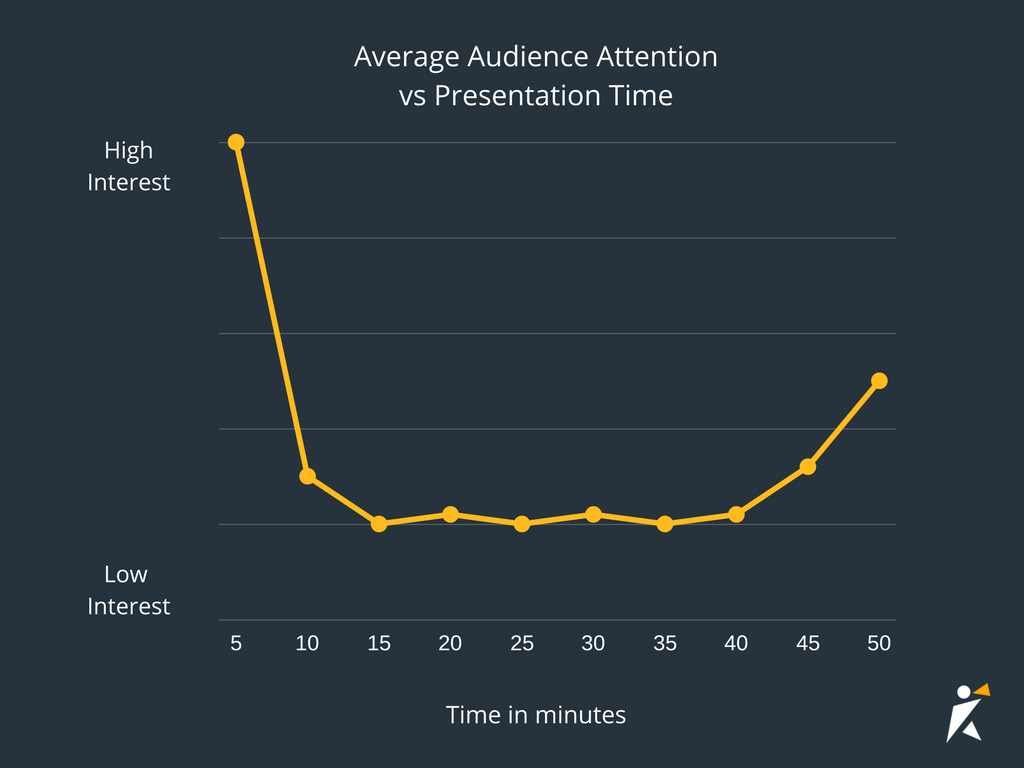
John Medina, a developmental molecular biologist and lecturer at the University of Washington, says peer-reviewed studies, as well as his own studies and observations, show that our brains will inevitably start to get bored after a mere ten minutes.
He measured the attention of his students over the course of a 50-minute lecture and saw that their interest fell drastically after the first ten minutes. It picked up again right at the end of his lecture in a swoop that looked something like this:
So, what to do? Limit every presentation to ten minutes?
No, we don’t need to be so drastic.
All we have to do is make a conscious effort to give the audience’s mind a break, and reset their attention, every ten minutes to keep interest at a high level.
With the ten minute resets, their interest looks more like this:

When you are building your presentation make sure you are consciously adding breaks and resets to keep the attention high.
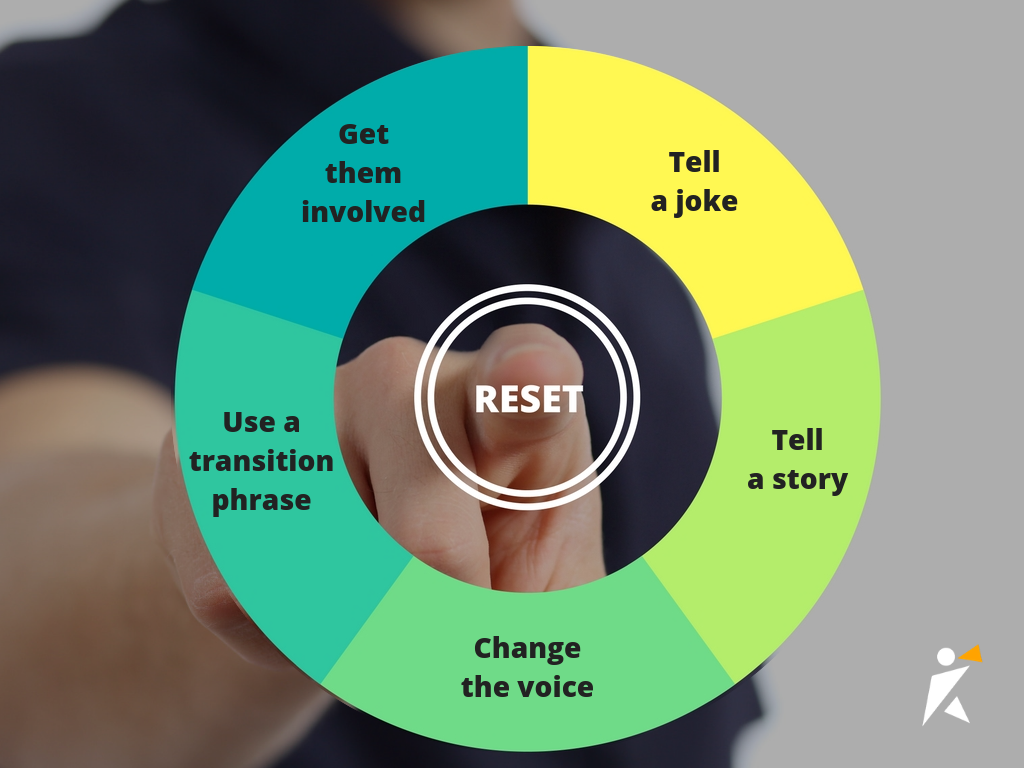
Avoid doing the same reset every 10 minutes, but use a variety of resets throughout your presentation.
Here are some examples:
“Let’s move on to…”
“Now, I’d like to discuss…”
“I strongly recommend that…”
“What I’d like to ask you to do now…”
“What I want you to take away from…”
What kind of stories should you tell, and when should you tell them? Here, are some ideas:
The fear of missing out is strong, and they will stay more focused in order to not miss the next funny moment.
If your audience has been paying attention, the joke will be a welcomed mental break. Either way, it is a win-win situation (as long as your joke is relevant and appropriate.)
Switching up the voice can be done in a variety of ways, for example, a co-presenter, short Q&A session, interview with a guest, question for the event organizer or host, or even playing a short video or audio recording.
Even if you’ve crafted a great session, sometimes you can still lose your audience. Maybe you’ve got the right-after-lunch session, or are following a presentation that was rather dull. There are still things you can do to get your audience engaged and back on track with you.
The Journal of Vision published a study showing that the human brain is wired to quickly and intuitively pick up on the overall emotional frequency of an audience, but it takes awareness to act on it. Here, are some key tools to know what to do when they are getting bored or distracted.
1. Be honest about how you are doing.
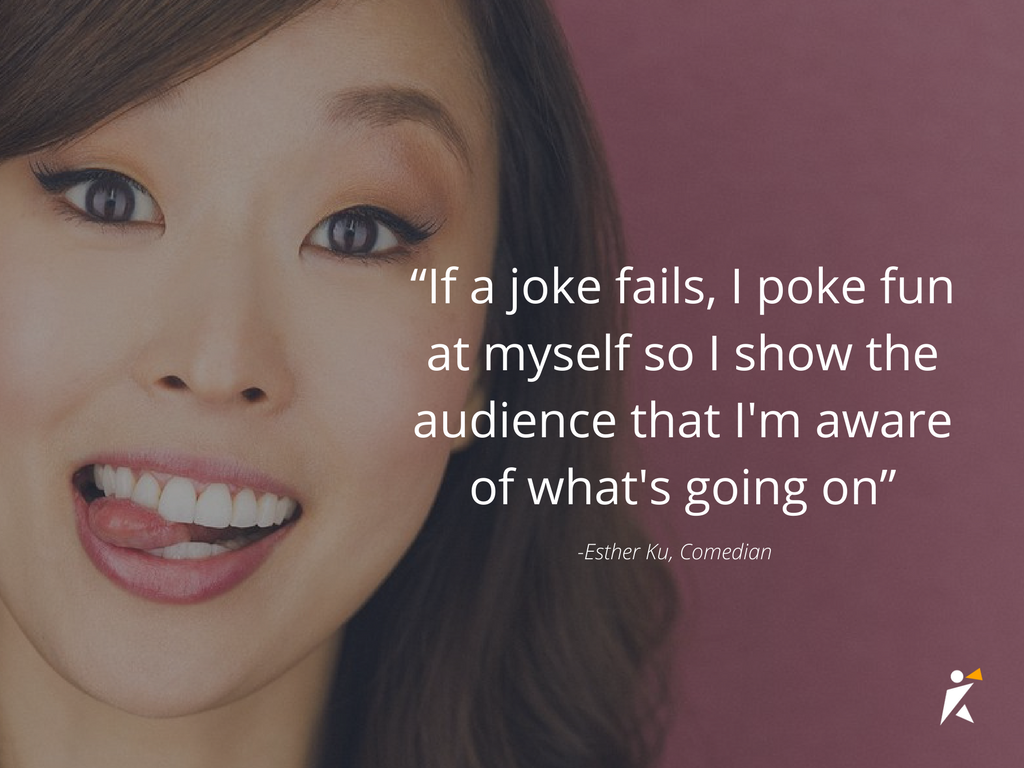
“If a joke fails, I poke fun at myself so I show the audience that I'm aware of what's going on”
-Esther Ku, Comedian
One of the worst things you can do is simply ignore the fact that you are not connecting with your audience, pretending that it will pick up, or that there is something there that isn’t. Acknowledging that they might be bored or disengaged can do a world of good for getting them back into focus.
2. Make a change.
Audiences pay attention to change. It alerts their brain that something is happening and they should pay attention.
Here are some ideas:
Switch from a PowerPoint to a whiteboard or flipchart.
Get your co-presenter or event organizer on stage to change the voice for a minute.
Get the audience to move in some way. This could mean something simple like a show of hands, turning to speak to their neighbor, or something more advanced like moving around the room.
3. Move around
Our brains are also hardwired to be on the lookout for simulation. The human eye fixates on two points a second, endlessly searching for new information to feed the brain. One of the easiest ways is to give the brain something new to fixate on: you moving.
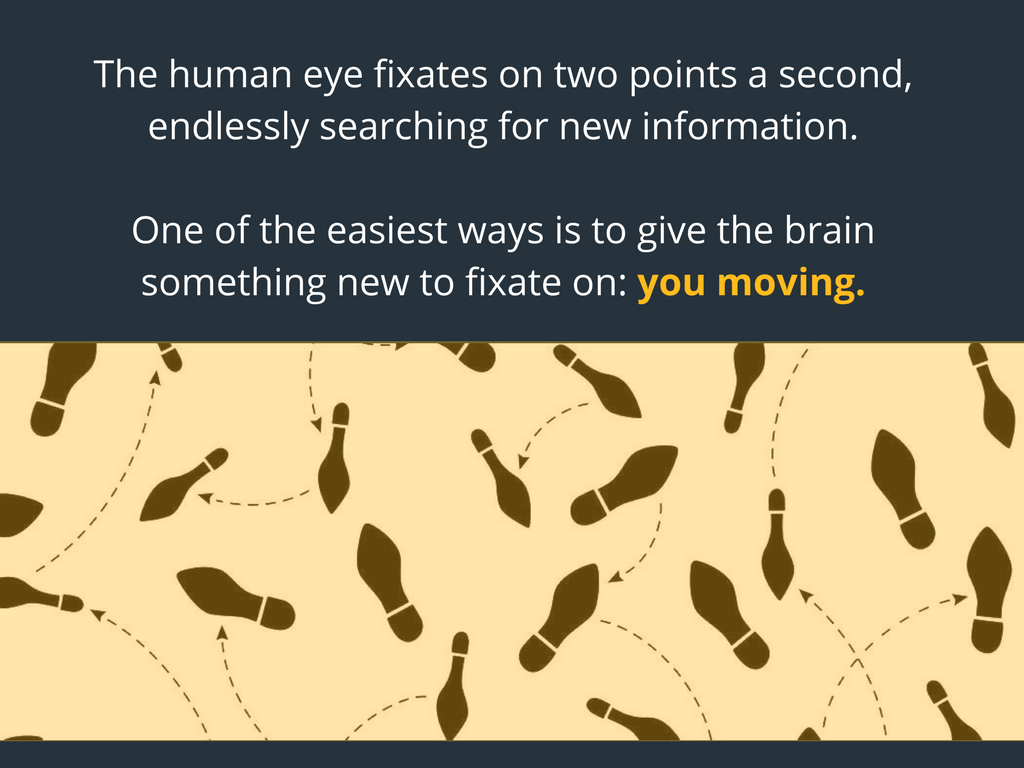
Whether this means you move from one side of the stage to another, you sit down and stand up, or you point to something, the movement will catch their eye.
This doesn’t mean you should be pacing around the stage like a lion in a cage, but moving every 5-10 seconds will keep your audience paying attention.
Every once in a while, you might make a doozy of a presentation. It happens.
The important thing to remember is to keep practicing and improving your anti-boredom techniques. Make notes of what sections of your talk or presentation the audience tends to tune-out, and make constant tweaks to make your session stronger.
Set up a profile and get new speaking opportunities: Sign up for SpeakerHub here.
Popular Categories