


If you are going to hire a guest speaker or an independent contractor to speak or work at your firm, there are a number of things that you should know about the process. You probably have a lot of questions: How to hire someone as an independent contractor? How do I find speakers and other appropriate candidates? What forms do I need to hire an independent contractor? What makes a good speaker?
Rest assured, there is a logical process that you can follow to find the best possible candidates for the job. There are some procedures that are common to both hiring processes, and others that are unique to each. Let’s take a look at how these both work.
In both cases, you will want to cast your net wide in terms of your search. If you are looking for guest speakers, you should utilize your personal network as much as possible. In addition, use public listings and directories relevant to the field in which the desired speaker works.
Once you’ve collected a pool of applicants, you will want to start narrowing down the selection. Your process should consist of two phases, pre-screening, and in-person screening.
In the case of hiring guest speakers, you should look up speeches that your candidates have already given. Even if your desired speakers are really big names in their field, they might not be the greatest speakers in the world (this often happens in academia, for example). You’ll also want to determine other criteria before you contact them, including the following:
Their standard rate
Whether or not they require travel expenses, accommodation, extra perks, etc
Whether or not you will need to go through an agent
In employing independent contractors, you should look at the following factors:
Online, independent (not from their own websites) reviews, including
Reliability
Efficiency
Timeliness
Character
Standard rates
Compatibility with exactly the services you require
Now that you’ve gotten a list of potential speakers together, you will want to start looking at them more closely to determine who will be the best match for your needs. Your in-person (or online, as the case may be) screening should include the following:
Get a sense of each speaker’s character and whether or not you feel they would appeal to your audience.
Figure out if they are willing to compromise on fees if necessary.
Determine the themes the speakers wish to discuss and whether they would be a good match for your audience.
Be sure of the speakers’ availability on your desired dates.
In determining how to hire an independent contractor, your second-phase screening process should determine the following:
The potential contractors’ compatibility with your desired services
The timeframe within which each contractor expects to be able to fulfill the job
The candidates’ characters, and whether you think they would be a match for your company
Other conditions not laid out officially that candidates may have for hiring
Once you have determined your desired candidates, you will need to conduct background checks. This goes for both guest speakers and independent contractors. References are an important part of the process as people can put any number of things on their resumes and some may not be accurate. If potential speakers claim to have spoken at certain places, contact those places to verify the candidates’ claims, and also try to speak to the people that hired them to find out how well they were received.
In hiring guest speakers, you will likely want to have your screening process involve different phases with different groups of people. You will want to choose a speaker that has wide appeal to your audience, and therefore it is advisable that your candidates be screened by different levels of your administration. If you work for a university, for example, you will likely want to have your dean, senior faculty and staff, and possibly board members look at candidates before you hire them. This way, you will improve your chances of making the right selection.
Similarly, in determining how to hire someone as an independent contractor, you should contact the companies your candidates have worked for in the past, and assess the candidates’ performance in the following respects:
Whether they completed the job in full
Whether they showed up and finished on time
How friendly and professional they were with your staff and clients
To what extent they followed company policy
Any other factors that might not be listed publicly
You should also check the company's website and other social media to ensure that they are accurate and in keeping with third-party reviews.
At this point, you will have your desired candidates. You will need to create formal contracts so as to ensure that all the necessary points are fully laid out and legally binding so that you don't run into unexpected issues.
Your contracts should include (but not be limited to) these points:
The exact goods or services they will provide
The daily schedule (for contractors) and timeframe that you want services fulfilled in
The hourly rate / lump sum that you will pay
Any other benefits that you will provide (insurance, travel expenses, per diem, etc)
Any relevant confidentiality requirements
Conditions for termination of the agreement
To see an example of an independent contractor agreement, click on this link.
Depending on where you live, you may have to fill out required tax documentation. For example, if you are living in the United States, you will need to have the contractor fill out a W-9 form and check the Employee Identification Number (EIN) of his or her company.
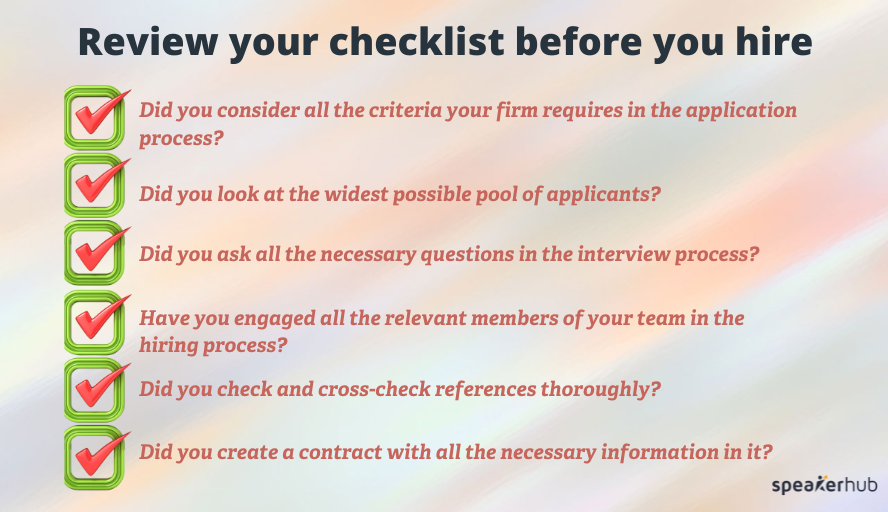
Before you take on your temporary hires, be sure to review your checklist again:
Did you consider all the criteria your firm requires in the application process?
Did you look at the widest possible pool of applicants?
Did you ask all the necessary questions in the interview process?
Have you engaged all the relevant members of your team in the hiring process?
Did you check and cross-check references thoroughly?
Did you create a contract with all the necessary information in it?
If you can answer all these questions with confidence, you can rest assured that you've done all you can to find the best candidate for the job. Now you just have to be sure that the work is carried out effectively.
Popular Categories